22nd of March

How Schools Are Going Solar


How Schools Are Going Solar

The cost for individual homes in the U.S. to “go solar” has dropped by more than 60 percent over the last decade.

Those low costs helped convince more than a million Americans to install solar panels on their roofs.

Now schools are beginning to get in on the benefits. One of them is the school system in Fremont, Indiana.

The residents of this small town in America’s upper Midwest have always relied on the sun to warm their fields and draw tourists to their lakes. Now school superintendent William Stitt said they’re counting on it to power their schools.

“The technology has advanced so much in the last couple of years that it’s become more energy efficient, more cost effective for schools to get solar energy,” Stitt said.

Start-up cost

Construction of the solar project will cost $3 million. But when finished, it will completely power the elementary, middle and high school buildings. It may generate so much electricity, that the school will be able to sell some back to the power company at a profit. Read more…

How Schools Are Going Solar

17th of March

There’s Vast Untapped Potential for Solar Rooftops in the US, Says Google


There’s Vast Untapped Potential for Solar Rooftops in the US, Says Google

When Google first launched a website two years ago that collects data on solar rooftops, called Project Sunroof, it only covered a few cities. But this week, the search engine giant announced the solar site is now crunching data for every single U.S. state, including 60 million rooftops across the country.

The expansion means that Google’s Project Sunroof is starting to get a much clearer picture of how much rooftop solar capacity there actually is in the U.S. Project Sunroof uses data from Google Maps and Google Earth, combined with 3-D modeling and machine learning to determine the solar electricity potential of individual roofs.

Potential solar customers — or just the solar-curious — can enter their addresses into the site and get information about how much a solar system on their roof might cost and how much money they might save over time by going solar.

Google’s product manager Joel Conkling told GTM the goal of Project Sunroof is “to get data into the hands of people thinking about solar, and who are making decisions about solar.” He added that “the hope is [to] help people make more quantitative decisions about solar.” Read more…

There’s Vast Untapped Potential for Solar Rooftops in the US, Says Google

15th of March

Google’s New Tool Says Nearly 80 Percent of Roofs Are Sunny Enough for Solar Panels


Google’s New Tool Says Nearly 80 Percent of Roofs Are Sunny Enough for Solar Panels

The company’s Project Sunroof lets you look up your house and helps you decide whether to invest in your own clean power plant.

If you’ve ever thought about getting solar panels on your house but worried about whether it was worth it, Google may now have just the thing to help you decide.

In a new expansion of its Project Sunroof, the company has built 3-D models of rooftops in all 50 states, looked at the trees around people’s homes, considered the local weather, and figured out how much energy each house or building can generate if its owners plunk down for some panels.

Top among the findings is that nearly 80 percent of all buildings the team modeled are “technically viable” for solar panels, meaning they catch enough rays each year to make generating electricity feasible. That sounds pretty good, and a post on Google’s blog goes on to highlight the rooftop-solar potential for several cities. Houston comes out on top, with as much as 18,940 gigawatt-hours of free energy from the sun just waiting to be generated each year (Google says that a gigawatt-hour translates to about a year’s supply of electricity for 90 homes).

Sunroof lets you search for your house, suggests how large a solar array you might consider putting on your roof, and estimates how much energy it will generate—as well as how much it would cost to lease or buy the panels. Read more…

Google’s New Tool Says Nearly 80 Percent of Roofs Are Sunny Enough for Solar Panels

14th of March

Google’s Project Sunroof now shows solar potential in all 50 states


Google’s Project Sunroof now shows solar potential in all 50 states

Google today announced another expansion of Project Sunroof, its web app for showing how much money you can save by installing solar panels at home. Now people can check locations in areas within all 50 U.S. states.

That’s up from 42 states in May 2016, 9 states in December 2015, and just 3 metro areas in August 2015, when Google first announced the initiative. Now Google has determined how much solar power panels can collect on more than 60 million buildings across the country, Google product manager Joel Conkling wrote in a blog post.

The service now lets people check locations in Idaho, Mississippi, and Texas, among other states. The city with the greatest solar potential in terms of number of gigawatt-hours (GWh) per year is Houston, Conkling wrote.

Google uses solar farms to generate energy for its facilities, including data centers. In December the company said it would become completely reliant on renewable energy in 2017.

In November Google introduced a Data Explorer for Project Sunroof that provides estimates of the effects of switching to solar across entire communities. Read more….
Google’s Project Sunroof now shows solar potential in all 50 states

10th of February

Online Tool to Help Solar Customers Avoid Getting Burned


Online Tool to Help Solar Customers Avoid Getting Burned

Many San Antonians purchased and installed solar panels on their rooftops for the first time over the past several years – about 9,200 CPS Energy customers will have taken advantage of the utility’s solar rebate program by the end of February.

But customers like Cathy Leary and others have buyers remorse.

A local company installed a 6.4 kilowatt system, 20 panels, at Leary’s home in Alamo Heights in spring 2016. The documents they provided her said the solar panels would supply “101% of annual electrical use,” zeroing out her electricity bill. She paid $3.60 per watt.

“All along the way … I kept saying, ‘Are you sure we can have solar panels? We have so much shade,’” Leary recalled. She has two large trees on the west and east sides of her house – she used to have a third until the recent hail storm knocked one down. Her panels, especially when the trees are filled with leaves (most of the year), barely get any sun. Read more…

Online Tool to Help Solar Customers Avoid Getting Burned

6th of February

Small, Distributed Solar Companies Are Retaking the Industry. Here’s Why


Small, Distributed Solar Companies Are Retaking the Industry. Here’s Why

Powerhouse is a solar startup incubator in Oakland. The effort was founded by the industry veterans Emily Kirsch and Danny Kennedy, both of whom have ridden through the many ups and downs of the solar industry over the last decade. Of course, like any good incubator, they needed some swag to share with visiting dignitaries. Given their history in the space, then, it’s no surprise that Emily came up with drink coasters to share, calling them “solar coasters.”

The solar industry’s famous ups and downs are often the result of supply and demand booms and busts, followed by whiplash in the profit margins of module suppliers, project developers and installers. But the solar-coaster ride has some other important implications.

One is playing out in the U.S. residential space right now. While much will be written about a potential decline in the overall solar market this year, the real action will be in residential solar rooftops. Utility and commercial-scale solar will likely see a decline this year. However, residential installations will continue to rise. This is due to nationally diverse demand, continued lower prices, and solar-friendly state policies.

The other big driver keeping residential solar on the upward track is the growing simplicity of financing. Over the last decade, companies like SolarCity, Vivint and Sunrun have helped bring solar within reach for millions of Americans with the innovations of tax-equity-based power-purchase agreements (PPAs). Primarily because of the need to aggregate very large amounts of tax equity, these new third-party ownership models favored larger, consolidated companies such as those mentioned above. Read more…

Small, Distributed Solar Companies Are Retaking the Industry. Here’s Why

2nd of February

Falling green energy costs ‘to stop’ fossil fuel growth


Falling green energy costs ‘to stop’ fossil fuel growth

Falling costs of renewable energy technologies could lead to a halt in the growth of global demand for environmentally harmful fossil fuels, according to a new report.

Released on Thursday, the report – co-authored by the Grantham Institute at Imperial College London and the UK-based think-tank Carbon Tracker Initiative, showed that cheaper electric vehicles and solar technology, and their increasing use globally, could stop growth in demand for oil and coal by 2020.

The study said that growth in electric vehicles (EVs) alone could lead to two million barrels of oil per day (mbd) being displaced by 2025, which is the same volume that caused the oil price collapse in 2014-15.

“This scenario sees 16 mbd of oil demand displaced by 2040 and 25 mbd by 2050, in contrast to the continuous growth in oil demand expected by industry,” it added. Read more…

Falling green energy costs ‘to stop’ fossil fuel growth

26th of January

Solar energy jobs are growing 12 times faster than the US economy


Solar energy jobs are growing 12 times faster than the US economy

If you’re looking to switch careers, you might want to listen to the wind.

According to a new report, wind turbine technician is the fastest growing profession in the United States.

The growth in wind power is just one example of the rising employment numbers associated with the clean energy and sustainability sector. According to the report, published by the Environmental Defense Fund’s Climate Corps program, the industry now has at least 4 million jobs, up from 3.4 million in 2011.

The report estimates that solar and wind jobs are growing at a rate 12 times faster than the rest of the US economy, and suggests that 46% of large firms have hired additional staff to address issues of sustainability over the last two years.

Those impressive gains stand in contrast to Donald Trump’s stance on energy. The president has consistently championed eliminating environmental regulations and increasing fossil fuel production as a promising way to bring jobs to America. Read more…

Solar energy jobs are growing 12 times faster than the US economy

26th of January

In big boost to Modi’s power push, Adani sets up world’s largest solar plant in India


In big boost to Modi’s power push, Adani sets up world’s largest solar plant in India

It took 8,500 men working two shifts every day for six months – and three shifts for two months – to finish, ahead of schedule, the Adani Group’s giant solar power plant in southern India.

The vast, 10 sq km project in Ramanathapuram, in the southern state of Tamil Nadu, is the world’s largest solar power station in a single location, according to the company.

It has the capacity to power 150,000 homes – and it is one sign of how serious India is becoming about meeting its renewable energy targets.

Considering the delays that commonly bog down infrastructure projects in India, the speed at which the 648 megawatt project was completed demonstrates the country’s commitment to renewables, said an analyst.

“The government is very clear about its solar plan, and large installations are key to this plan,” said Aruna Kumarankandath of the Centre for Science and Environment in Delhi.

Prime Minister Narendra Modi “is a real evangelist”, and has prioritised solar to meet the renewables target, she said. Read more…

In big boost to Modi’s power push, Adani sets up world’s largest solar plant in India

15th of January

Wavus Camp for Girls goes solar


Wavus Camp for Girls goes solar

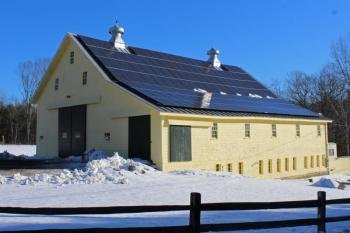
A 36.4 kilowatt grid-tied solar electric array was recently installed at Wavus Camp for Girls in Jefferson on Damariscotta Lake.

The system, designed and installed by ReVision Energy of Liberty, took less than two weeks to fully install. Now, 136 solar panels cover the Wavus Barn roof and will supply 11 percent of Kieve-Wavus’ annual electric use and will offset almost 20 tons of carbon pollution each year. The new solar electric system will join Kieve-Wavus Education’s existing solar hot water arrays on the Kieve campus and will further demonstrate the organization’s commitment to environmental stewardship.

“The orientation and solar exposure of the Wavus Barn is ideal for this technology,” says Jennifer Jackson Albee, ReVision Energy’s Customer Relations Manager and a former Wavus camper. “A system this size will produce more than 42,000 kilowatt hours of electricity annually and make power for thirty years or more.”

“Kieve-Wavus Education is very excited about this project,” says Henry Kennedy, Executive Director, “as it will not only help to reduce our energy costs, but it will also be utilizing a renewable energy source and is less impactful on the environment than other energy sources.”  Wavus Camp for Girls Director, Kirstie Truluck, said, “We are excited about the opportunity to expose our students first hand to solar production of electricity and to share the many values we see in this technology with our campers, families and community.  The solar array sits just a few yards above the camp garden in which campers spend some time each day tending to the growing plants and discovering the joys of fresh food.  It will be enlightening to experience firsthand more of the ways the sun’s energy can be harnessed and put to good work.”Read more….

Wavus Camp for Girls goes solar