9th of July

Faster Rooftop Solar Growth to Cut Demand From Biggest U.S. Grid


Faster Rooftop Solar Growth to Cut Demand From Biggest U.S. Grid

Rooftop-solar panels are being installed in the region covered by the biggest U.S. power grid at a faster pace than expected. That will accelerate the shift away from large generators.

Distributed solar generation on the grid managed by PJM Interconnection LLC, which serves more than 61 million people in the East, jumped 30 percent in April from a year earlier. That rate of growth will likely continue with the extension of tax credits, CreditSights Inc. said in a report Friday. PJM previously forecast that installations would climb by 31 percent this year before slowing to 18 percent in 2017 and 12 percent in 2018.

The rise of solar means that the grid operator may need to secure less supply to meet needs on the hottest days of the year, cutting payouts to owners of nuclear, natural gas and coal plants. Households are going solar as companies like SolarCity Corp. make a big push in parts of the mid-Atlantic states to take advantage of state initiatives. Read More…

Bungalow / VillaApartmentFactoryHospitalOther Insitutions
To save money on electricity bills
To be energy independent
To have a cleaner environment
For my nations energy independence

Faster Rooftop Solar Growth to Cut Demand From Biggest U.S. Grid

7th of July

जोधपुर : देश की पहली सोलर ट्रेन का संचालन शुरू


जोधपुर : देश की पहली सोलर ट्रेन का संचालन शुरू

Jodhpur Train 1 Jodhpur Train

सौर बिजली
बिजली के बिल पर पैसे बचाने के लिए
ऊर्जा स्वतंत्र होने के लिए
देश का वातावरण स्वच्छ बनाने के लिए
मेरे राष्ट्र की ऊर्जा स्वतंत्रता के लिए

जोधपुर : देश की पहली सोलर ट्रेन का संचालन शुरू

6th of July

सौर ऊर्जा से चलता है अंतरिक्ष यान जूनो


सौर ऊर्जा से चलता है अंतरिक्ष यान जूनो

Solar Yan

सौर बिजली
बिजली के बिल पर पैसे बचाने के लिए
ऊर्जा स्वतंत्र होने के लिए
देश का वातावरण स्वच्छ बनाने के लिए
मेरे राष्ट्र की ऊर्जा स्वतंत्रता के लिए

सौर ऊर्जा से चलता है अंतरिक्ष यान जूनो

5th of July

World Bank deal will boost Solar Globally


World Bank deal will boost Solar Globally

The World Bank Group today signed an agreement with the International Solar Alliance (ISA), consisting of 121 countries led by India, to collaborate on increasing solar energy use around the world, with the goal of mobilizing $1 trillion in investments by 2030.

The agreement signed in the presence of Finance Minister Arun Jaitley, Union Minister of State with Independent charge for Power, Coal, New and Renewable Energy Piyush Goyal and World Bank Group President Jim Yong Kim establishes the World Bank Group as a financial partner for the ISA and sees the institution as using its global development network, global knowledge and financing capacity to promote the use of solar energy.

The World Bank also announced that it planned to provide more than $1 billion to support India’s ambitious initiatives to expand solar through investments in solar generation. The World Bank-supported projects under preparation include solar rooftop technology, infrastructure for solar parks, bringing innovative solar and hybrid technologies to market, and transmission lines for solar-rich states. These solar investments for India combined would be the Bank’s largest financing of solar for any country in the world to date.

“India’s plans to virtually triple the share of renewable energy by 2030 will both transform the country’s energy supply and have far-reaching global implications in the fight against climate change,” said World Bank Group President Jim Yong Kim. “Prime Minister Modi’s personal commitment toward renewable energy, particularly solar, is the driving force behind these investments. The World Bank Group will do all it can to help India meet its ambitious targets, especially around scaling up solar energy.”

Kim said he also hoped the signing of the agreement with the ISA would help mobilize a global movement toward a climate-friendly future.

As part of the agreement, the Bank Group will develop a roadmap to mobilize financing for development and deployment of affordable solar energy, and work with other multilateral development banks and  financial institutions to develop financing instruments to support solar energy development.

In keeping with the Bank’s commitment to support India’s solar energy program, the Government of India and the World Bank today signed an agreement for the $625 million Grid Connected Rooftop Solar Program. The project will finance the installation of at least 400 MW of solar Photovoltaic (PV) installations that will provide clean, renewable energy, and reduce greenhouse gas emissions by displacing thermal generation. The development of a $200 million Shared Infrastructure for Solar Parks Project under a public-private partnership model is also under preparation. The Bank’s support for India’s solar projects will increase the availability of financing, introduce new technologies, build capacity for solar rooftop units and enable the development of common infrastructure, which will support privately developed solar parks in a number of states across India.

International Finance Corporation (IFC), the Bank Group’s private sector arm, was one of the earliest financiers of wind and solar projects in India, and in fact helped develop the country’s first grid-connected solar power project. IFC is also supporting the government of Madhya Pradesh to set up the 750-MW Rewa ultra-mega solar power project, which will be the largest single-site solar power project in the world.

The ISA was launched at the UN Climate Change Conference in Paris on 30 November by Indian Prime Minister Narendra Modi and French President Francois Hollande.

India is the largest client of the World Bank Group. Between 2015 and 2016, the Group lent around $4.8 billion to India.  This includes $2.8 billion from the International Bank for Reconstruction and Development (IBRD), $1.0 billion from the International Development Association (IDA) and approximately $1.0 billion in investments from the International Finance Corporation (IFC).  As of June 2016, total IBRD and IDA net commitments stood at $27 billion (IBRD $16 billion, IDA $11 billion) across 95 projects. At the end of May 2016, IFC’s India portfolio contained 248 projects, amounting to a committed and disbursed exposure of approximately $4.4 billion. Read More…

Bungalow / VillaApartmentFactoryHospitalOther Insitutions
To save money on electricity bills
To be energy independent
To have a cleaner environment
For my nations energy independence

World Bank deal will boost Solar Globally

30th of June

Here comes the sun: US solar power market hits all-time high


Here comes the sun: US solar power market hits all-time high

Solar energy in the US has had a rocky existence. Ever since Ronald Reagan symbolically removed Jimmy Carter’s solar panels from the White House roof in 1986, federal policy has been unpredictable, such that manufacturers and consumers could never depend on reliable incentives to produce and install solar energy systems.

Remarkably, the US solar energy industry is now entering what may be its most prosperous decade ever, thanks to a new wave of federal and state policies and positive economics in the industry, both at home and abroad.

“I think it will actually be bigger than people are projecting,” says Jigar Shah, president and co-founder of Generate Capital, a clean energy investment firm based in San Francisco. “The solar industry is booming right now.” Read More…

Bungalow / VillaApartmentFactoryHospitalOther Insitutions
To save money on electricity bills
To be energy independent
To have a cleaner environment
For my nations energy independence

Here comes the sun: US solar power market hits all-time high

28th of June

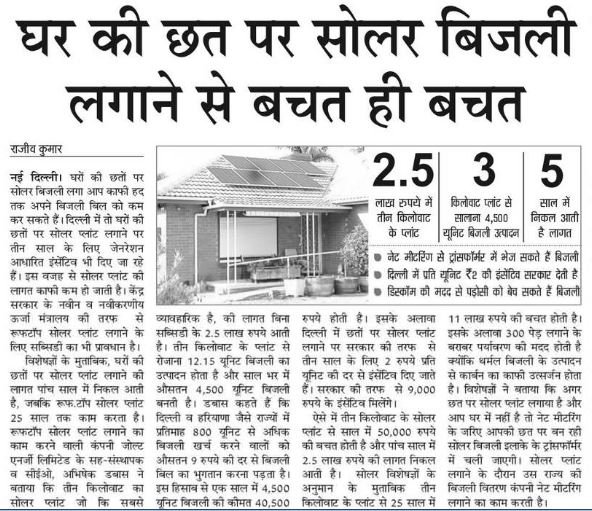
घर की छत पर सोलर बिजली लगाने से बचत ही बचत


घर की छत पर सोलर बिजली लगाने से बचत ही बचत

Rooftop-news-June28-Hindi

घर की छत पर सोलर बिजली लगाने से बचत ही बचत

सौर बिजली
बिजली के बिल पर पैसे बचाने के लिए
ऊर्जा स्वतंत्र होने के लिए
देश का वातावरण स्वच्छ बनाने के लिए
मेरे राष्ट्र की ऊर्जा स्वतंत्रता के लिए
28th of June

How to go solar without putting panels on your roof


How to go solar without putting panels on your roof

If you’d like to use solar power in your home but can’t put panels on your roof, help may be on the way. Over the past few months, several states passed legislation to support the concept of community solar, which gives homeowners the chance to use solar instead of conventional power.

Community solar allows consumers to share solar power from a common system with other consumers. The source of the solar power can be owned by municipal utilities, independent solar developers, a group of homeowners or businesses, or community and nonprofit organizations such as electric co-ops. There are various models in which such projects are operated and billed — participants can own, lease or subscribe to a specified number of panels or a portion of the system and typically receive electricity or monetary credits in proportion to their share of the project. Consumers who opt for community solar continue to work with their utility, but sign on for solar in addition to conventional energy.

Today, there are about 15.8 million homes in the U.S. that have the potential to go solar, according to GTM Research, the research arm of energy media company Greentech Media. Only a sliver of these homes have installed rooftop solar power systems. About 49% of American households wish to go solar but can’t because they don’t have the right kind of roof to host solar panels, they don’t own the houses they live in, or can’t afford to invest in the systems, which may take about four years to pay back, according to the National Renewable Energy Laboratory, a Colorado-based government institution that conducts research and development in renewable energy and energy efficiency . The solution? Community or shared solar, the segment that experts believe will drive the solar market over the next few years, as more states in the country pass legislation to support it. Read More…

How to go solar without putting panels on your roof

Bungalow / VillaApartmentFactoryHospitalOther Insitutions
To save money on electricity bills
To be energy independent
To have a cleaner environment
For my nations energy independence

22nd of June

Musk Proposes $2.9B ‘No Brainer’ Tesla-SolarCity Deal


Musk Proposes $2.9B ‘No Brainer’ Tesla-SolarCity Deal

Tesla Motors has offered $2.9 billion to acquire SolarCity in a bid to combine clean energy business efforts, as shareholder balk at the potential deal. Bloomberg’s Matt Miller reports on “Bloomberg .” Read More…

Musk Proposes $2.9B ‘No Brainer’ Tesla-SolarCity Deal

Bungalow / VillaApartmentFactoryHospitalOther Insitutions
To save money on electricity bills
To be energy independent
To have a cleaner environment
For my nations energy independence

14th of June

Contact Us


Contact us for these phone numbers, or Complete the form below:

USA : 40774597720
India: 01416982222
GCC : 97470134020

14th of June

Future of Rooftop Solar: Loan Product Could Transform SolarCity Corp


Future of Rooftop Solar: Loan Product Could Transform SolarCity Corp

SolarCity Corp (NASDAQ:SCTY) has struggled to live up to its own expectations for most of the last year and it’s showing in the company’s stock price. The former market darling has lost nearly two-thirds of its value and investors are now wondering what its future looks like. A new loan product launched this quarter could tell us a lot about the future of residential solar and how SolarCity fits in that future.

Saving customers more money -Solar leases, often known by their other name “power purchase agreements”, both terms describing an arrangement where a customer pays for solar energy over the course of 20 years or more, have been the dominant financing method in residential solar over the past five years, but that may be ending. Solar loans, where the customer actually buys solar panels with a loan, provide a lot of benefits that leases can’t.

They don’t like advertising it, but SolarCity and Vivint Solar (NYSE:VSLR) normally charge increasing prices over time, meaning over the course of 20 years the cost of a kWh of energy could nearly double. If electricity prices don’t rise at the same rate or faster the cost of solar could be underwater by the end of the contract. Read More….

Future of Rooftop Solar: Loan Product Could Transform SolarCity Corp

Bungalow / VillaApartmentFactoryHospitalOther Insitutions
To save money on electricity bills
To be energy independent
To have a cleaner environment
For my nations energy independence