26th of January

In big boost to Modi’s power push, Adani sets up world’s largest solar plant in India


In big boost to Modi’s power push, Adani sets up world’s largest solar plant in India

It took 8,500 men working two shifts every day for six months – and three shifts for two months – to finish, ahead of schedule, the Adani Group’s giant solar power plant in southern India.

The vast, 10 sq km project in Ramanathapuram, in the southern state of Tamil Nadu, is the world’s largest solar power station in a single location, according to the company.

It has the capacity to power 150,000 homes – and it is one sign of how serious India is becoming about meeting its renewable energy targets.

Considering the delays that commonly bog down infrastructure projects in India, the speed at which the 648 megawatt project was completed demonstrates the country’s commitment to renewables, said an analyst.

“The government is very clear about its solar plan, and large installations are key to this plan,” said Aruna Kumarankandath of the Centre for Science and Environment in Delhi.

Prime Minister Narendra Modi “is a real evangelist”, and has prioritised solar to meet the renewables target, she said. Read more…

In big boost to Modi’s power push, Adani sets up world’s largest solar plant in India

15th of January

Wavus Camp for Girls goes solar


Wavus Camp for Girls goes solar

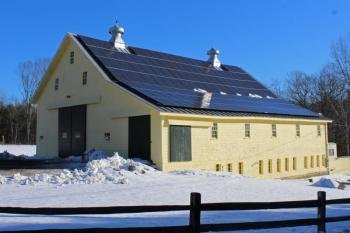
A 36.4 kilowatt grid-tied solar electric array was recently installed at Wavus Camp for Girls in Jefferson on Damariscotta Lake.

The system, designed and installed by ReVision Energy of Liberty, took less than two weeks to fully install. Now, 136 solar panels cover the Wavus Barn roof and will supply 11 percent of Kieve-Wavus’ annual electric use and will offset almost 20 tons of carbon pollution each year. The new solar electric system will join Kieve-Wavus Education’s existing solar hot water arrays on the Kieve campus and will further demonstrate the organization’s commitment to environmental stewardship.

“The orientation and solar exposure of the Wavus Barn is ideal for this technology,” says Jennifer Jackson Albee, ReVision Energy’s Customer Relations Manager and a former Wavus camper. “A system this size will produce more than 42,000 kilowatt hours of electricity annually and make power for thirty years or more.”

“Kieve-Wavus Education is very excited about this project,” says Henry Kennedy, Executive Director, “as it will not only help to reduce our energy costs, but it will also be utilizing a renewable energy source and is less impactful on the environment than other energy sources.”  Wavus Camp for Girls Director, Kirstie Truluck, said, “We are excited about the opportunity to expose our students first hand to solar production of electricity and to share the many values we see in this technology with our campers, families and community.  The solar array sits just a few yards above the camp garden in which campers spend some time each day tending to the growing plants and discovering the joys of fresh food.  It will be enlightening to experience firsthand more of the ways the sun’s energy can be harnessed and put to good work.”Read more….

Wavus Camp for Girls goes solar

11th of January

2017 United States Solar Power Rankings


2017 United States Solar Power Rankings

Hey folks! 2016 was a hell of a year, huh? Nowhere was that statement more true than in the solar industry. We’ve been through the ringer this year, with some big victories and big defeats.

We began the year with an extension to the all-important Federal Solar Investment Tax Credit, which served to put a lot of long-term fears to rest across the industry. That was good start, but it didn’t last long.

Almost at the same time, Nevada did away with its formerly-excellent net metering policies, setting the tone for a year full of contentious fights over how utility companies should pay homeowners for the solar energy they produce.

There’s a whole lot more to talk about, but for now, let’s jump right into the rankings.

This year, we analyzed 663 data points to judge the promise of solar in all of the 50 states and the District of Columbia.

As in past years, we graded each state based on 12 criteria, then weighted the criteria individually, and multiplied the values of the grades by the weights to determine rankings. Read more…

2017 United States Solar Power Rankings

10th of January

Solar rooftop 50% cheaper than diesel generator sets


Solar rooftop 50% cheaper than diesel generator sets

Recommending the housing societies to replace the diesel generator sets with the rooftop solar power systems, a study by Centre for Science and Environment (CSE) finds the clean energy option financially more attractive.

The study said the cost of power generation from a diesel generator set, including the capital cost, is Rs 27 to Rs 33 per unit as compared to rooftop solar tariff of less than Rs 10 per unit.

“In all the residential societies that CSE studied, the cost of power from solar rooftop with battery backup was found to be about half the cost of power generated by diesel generator sets,” said Chandra Bhushan, Deputy Director General at CSE.

According to the study, up to 3 giga-watt of solar rooftop can be installed in new residential societies over the next five-seven years.

The study points out the diesel generator sets have become more redundant due to reducing power outrage in cities. Read more…

Solar rooftop 50% cheaper than diesel generator sets

10th of January

Solar rooftop 50% cheaper than diesel generator sets


Solar rooftop 50% cheaper than diesel generator sets

Recommending the housing societies to replace the diesel generator sets with the rooftop solar power systems, a study by Centre for Science and Environment (CSE) finds the clean energy option financially more attractive.

The study said the cost of power generation from a diesel generator set, including the capital cost, is Rs 27 to Rs 33 per unit as compared to rooftop solar tariff of less than Rs 10 per unit.

“In all the residential societies that CSE studied, the cost of power from solar rooftop with battery backup was found to be about half the cost of power generated by diesel generator sets,” said Chandra Bhushan, Deputy Director General at CSE.

According to the study, up to 3 giga-watt of solar rooftop can be installed in new residential societies over the next five-seven years. Read more…

Solar rooftop 50% cheaper than diesel generator sets

7th of January

Low-income families join solar revolution with help of California NGO


Low-income families join solar revolution with help of California NGO

If you were to make a list of the poorest areas in Los Angeles, somewhere on that list would be Bertha Dortch’s neighbourhood in Inglewood. The 68-year-old is on a fixed income, but she’s chosen to take in her great-granddaughter and two foster children. On hot days, she faces difficult choices — does she keep the house cool, or buy groceries?

“Our electric bill was going sky high and I really couldn’t turn the air conditioning on,” Dortch says.

Now, her monthly energy bill is about to drop by more than a quarter. She’s getting solar panels installed on her bungalow, for free, under a state-funded program paid for by California’s cap-and-trade revenues.

  • California gives solar panels to low-income homeowners
  • Growth of residential solar power slowed by ‘zero incentive’ for renters

A pair of volunteers hauls a solar panel up to another group waiting on the roof. They belong to an NGO called Grid Alternatives, which recruits volunteers to help implement California’s $162-million Single-family Affordable Solar Homes incentive program.

Why should solar only benefit the wealthy?

That means lower electricity costs for participating households, which must be in disadvantaged neighbourhoods.

Before he became a Grid Alternatives solar installation supervisor, Nicolas Gomez worked for the country’s largest solar installer. He says he spent most of his time putting up panels in wealthy communities like Palm Springs. Read more…

Low-income families join solar revolution with help of California NGO

29th of December

The Biggest Clean Energy Advances in 2016


The Biggest Clean Energy Advances in 2016

lean energy made critical strides in 2016. The Paris Climate accords went into effect, the price of solar installations continued to drop, investments in renewable energy soared, offshore wind finally got under way in the United States, and scientists made a series of technical advances that promise to make sustainable energy increasingly efficient and affordable.

That last one is key, since invention is still the surest way to avoid the greatest impacts of climate change.  Today’s commercially available renewable technologies can’t meet all of the world’s energy demands, even if they’re scaled up aggressively. The United States comes up about 20 percent short by 2050, according to a thorough analysis by the National Renewable Energy Laboratory. Meanwhile, the U.N.’s Intergovernmental Panel on Climate Change concluded the world must cut greenhouse gas emissions by as much as 70 percent by midcentury, and to nearly zero by 2100, to have any chance of avoiding warming levels that could ensure sinking cities, mass extinctions, and widespread droughts. Read more…

The Biggest Clean Energy Advances in 2016

29th of December

Accepting the Reality of Climate Change Is Good for Business


Accepting the Reality of Climate Change Is Good for Business

The climate cause has lost an ally in the White House, but the private sector has ensured that the clean technology revolution is here to stay

Yes, climate change is an existential threat—one that keeps me up at night. But talking of fire and brimstone only inflames those who either (rightly) feel helpless in the face of this reality or those who have a vested interest in big oil or coal. So rather than preaching to the converted, what if we look to the billionaire luminaries who have taken up the climate cause as smart business?

All business ventures start with a challenge. World energy consumption is on the rise, as are global temperatures. Meanwhile, our planet only has so much oil and natural gas left for extraction, which will ultimately re-center the future economy on alternative fuels. To power the population’s energy needs, we must focus our attention — and capital—on affordable clean energy solutions, which have the added benefit of ensuring the future health of our planet.

Last year, Bill Gates announced the Breakthrough Energy Coalition, an international partnership driven by 30 entrepreneurs, including Amazon founder Jeff Bezos and Alibaba chief Jack Ma, committed to investing in an emission-free future. Yesterday, the Coalition announced the launch of the Breakthrough Energy Ventures (BEV). The venture fund will invest over $1 billion on the next generation of clean energy innovations that provide the world with “reliable and affordable energy, foods, goods, and services without emitting greenhouse gases.” Read more…

Accepting the Reality of Climate Change Is Good for Business

23rd of December

10 Predictions for Rooftop Solar in 2017


10 Predictions for Rooftop Solar in 2017

I got lucky with my predictions for rooftop solar in 2016 — pretty much on target with nine out of the 10 darts that I threw. But this year is shaping up to be much more challenging, with routine solar-coaster turmoil combined with political uncertainty. Looking forward to 2017, my list no longer includes the benefits of the Clean Power Plan and 500 million solar panels (along with the EPA and half the equity in the remaining solar module companies). Nevertheless, I remain very optimistic about the future of clean technology industries simply because their economic benefits have been proven. So here are my 10 predictions for rooftop solar in 2017.

1. Module prices will stay at current low levels, roughly 35 cents for megawatt orders, roughly 45 cents for container quantities and roughly 55 cents for small orders. Manufacturers prefer to operate their production lines at full capacity (and full employment), even if they are selling at breakeven or less. As the year progresses, these low prices will apply to higher and higher efficiency modules. Differentiated modules — those with integrated electronics, simplified installation technology or 20+ percent efficiency — will command higher price points and margins simply because they provide more value to installers and homeowners.

2. U.S. solar manufacturing will continue to decline. Sadly, the module supply chain is almost entirely from Asia: wafers, cells, backsheets, EVA, junction boxes, glass and aluminum frames are all cheaper in China with comparable quality. Political rhetoric will not bring manufacturing back without a good plan to address the supply of key components in the U.S. Ironically, tariffs have made things much worse for U.S. manufacturers — removing tariffs on cells and extruded aluminum for solar would go a long way toward improving the economics for the remaining U.S. module manufacturers.

3. Community solar will struggle to get traction. Customers want both clean and cheap solar power. But when community solar is developed by utilities, they charge a premium for solar, so customers don’t buy. When lower per kilowatt-hour cost community solar projects are developed independently, utilities act to delay projects or increase costs in order to protect their monopoly. More local governments will step in with community-choice Aggregation programs. These CCA programs break the utility electricity sales monopoly, providing clean and cheap power to customers. Read more…

10 Predictions for Rooftop Solar in 2017
22nd of December

Third-Party rooftop solar units cost 40 per cent cheaper than discoms


Third-Party rooftop solar units cost 40 per cent cheaper than discoms

Rooftop solar units installed on industrial and corporate establishments by third parties are offering power 30-40% cheaper than the rates offered by the state’s power distribution companies. This gap is expected to widen further as thermal power companies would need to increase tariffs to accommodate inflationary measures and solar modules prices fall further.

The model ­ popularly called Opex model, includes a rooftop solar company setting up solar units on rooftops of industrial and commercial complex.

They would run the plant and sell the power to the company at a rate which is cheaper than tariffs at which the discoms sell power.

“Upfront investment for setting up solar units on rooftop are being undertaken by solar companies who are selling the power generated at a price which used to be 20% cheaper last year. This gap has now increased to as much as 40% for certain states,“ said Kuldeep Jain Managing Director, CleanMax Solar. Read more…

Third-Party rooftop solar units cost 40 per cent cheaper than discoms